
What does a facelift correct?
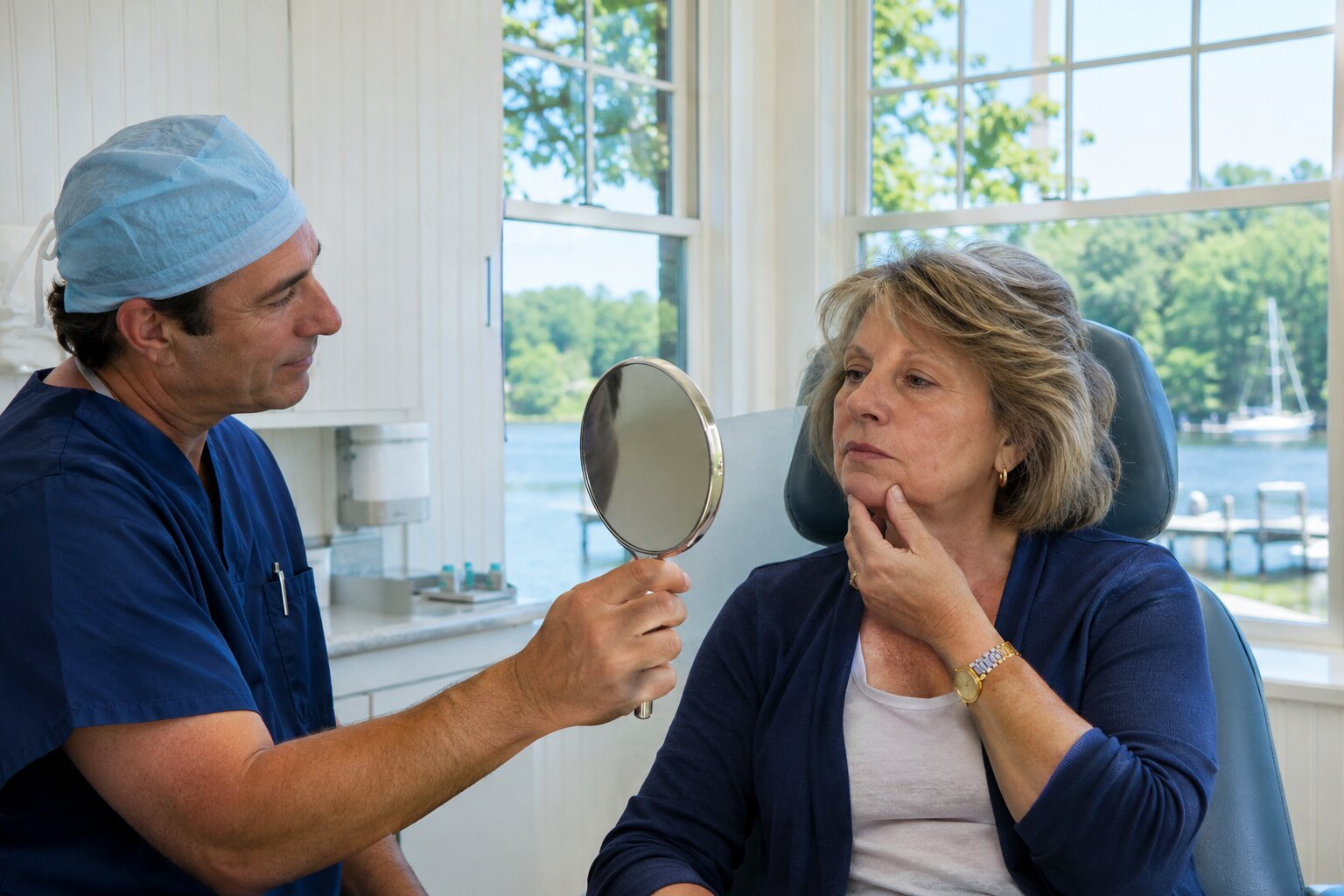
Before a facelift is weighed against anything else, it helps to know what the operation is built to fix and what it is not. This question belongs to the deciding stage, so the answer below is meant to be used before a consultation, not after one.
The signs a facelift targets
The American Society of Plastic Surgeons describes a facelift, or rhytidectomy, as a surgical procedure that improves visible signs of aging in the face and neck. Those signs include relaxation of the skin of the face causing sagging, deepening of the fold lines between the nose and corner of the mouth, fat that has fallen or has disappeared, jowls developing in the cheeks and jaw, and loose skin and excess fat of the neck that can appear as a double chin.
If your concern is on that list, a facelift is aimed at it. If it is not, the procedure may be answering a different question than yours.
Where the limits sit
The same organization is direct about what the operation cannot do. As a restorative surgery, a facelift does not change your fundamental appearance and cannot stop the aging process.
Read that as a planning fact. The face keeps aging after surgery, so the result is a better starting point, not a permanent one. Be skeptical of any promise that goes past the list above.
What the next stage will ask
Once you know what a facelift targets, the question that follows is whether your own face fits that description, and a surgeon examining you is the only person who can answer it. To read the procedure from several angles first, there is a facelift overview from healthdirect, a facelift page from UCSF Health, a MedlinePlus article on facelift and an NHS page on facelift (rhytidectomy). Healthdirect Australia, UCSF Health, MedlinePlus and the NHS each publish their own account.